Showing posts with label King Abdulaziz City for Science and Technology. Show all posts

Sunday, 6 May 2018

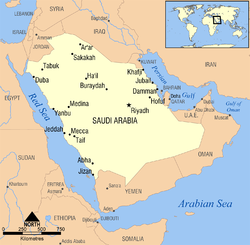
BADIR - Helping SME in Saudi Arabia

Author: Carport
Licence Creative Commons Attribution Share Alike 3.0 unported
Source Wikipedia Commons


Jane Lambert

According to the home page of the BADIR website, "badir" means "to initiate" in Arabic. BADIR is a programme to accelerate the growth of emerging technology businesses in Saudi Arabia.  It is an initiative of the King Abdul Aziz City for Science and Technology (see Saudi Arabia: King Abdulaziz City for Science and Technology 6 Sep 2012 and the video Introduction film about King Abdulaziz City for Science and Technology).

BADIR assists both Saudi and foreign businesses to establish and grow in Saudi Arabia, The services that it offers to Saudis are accelerators, boot camps, incubators and services for inventors.  The services that it offers to foreigners is what it calls "a soft landing" into Saudi  Arabia.

The first accelerator was launched in 2016 with 7 companies and lasted for 4 months.  The programme consisted of workshops, consultations and pitching for seed funding.

Boot camps are are intensive workshops in business modelling, finance, marketing lasting no more than a few days.  Two have recently taken place at Qassim and Riyadh.

There are incubators for advanced manufacturingbiotechnology and information and communications technology, Slightly different criteria apply for acceptance on each of those programmes and slightly different services and facilities are provided.  Incubators are located in Riyadh and Taif.

Help with patenting and commercialization is offered to inventors by BADIR.

BADIR helps established foreign companies with technology that is likely to benefit Saudi Arabia to establish themselves in that country.

Anyone wishing to discuss this article may call me on +44 (0)20 7404 5252 during normal British business hours or send me a message through my contact form.

Monday, 17 August 2015

After the oil runs dry - protecting inventions from GCC countries overseas

Beam pump in the West Kern Oil Museum in Tait, California, USA
Photo Konrad Summers
Creative Commons Licence
Source Wikipedia


Over the last few years the governments of the Gulf states have invested heavily in education and research to diversify their economies and lessen their dependence on oil and gas.  Saudi Arabia founded what is now the King Abdulaziz City for Science and Technology in 1977. Dubai established its International Academic City in 2007. The Qatar Foundation has set up Education City in Doha. Such investment appears to have led to good academic research but there have not yet been many applications for patents. Of the 205,268 applications for patents through the Patent Cooperation Treaty ("PCT") in 2013, Saudi Arabia accounted for 187, the United Arab Emirates 57, Oman 3 and Bahrain 2 (see page 41 of WIPO Facts and Figures 2014 ). As for applications to the Gulf Co-operation Council ("GCC") and national patent offices, there were 2,991 to the GCC 1,426 to the United Arab Emirates, 931 to Saudi Arabia, 332 to Qatar and 170 to Bahrain.

Patents are important because they confer a monopoly of a new invention. Art 28 (1) of the Agreement on Trade-Related Aspects of Intellectual Property Rights ("TRIPS") requires member states of the World Trade Organization to provide that:
"A patent shall confer on its owner the following exclusive rights:
(a) where the subject matter of a patent is a product, to prevent third parties not having the owner’s consent from the acts of: making, using, offering for sale, selling, or importing for these purposes that product;
(b) where the subject matter of a patent is a process, to prevent third parties not having the owner’s consent from the act of using the process, and from the acts of: using, offering for sale, selling, or importing for these purposes at least the product obtained directly by that process."
Such monopolies are granted to stimulate research and development.  By restricting the exploitation of a new invention to patent owners, inventors and their investors have an opportunity to recoup their expenditure and perhaps earn a little extra.

In order to maximize a new invention patents should be sought not just for the country in which the invention was invented but also for the countries where the invention or its products are likely to be sold and those in which they could be manufactured.  Two international agreements facilitate patenting of new inventions:
Art 4 of Paris gives applicants for patents up to 12 months priority from the date upon which they make their first application. The PCT facilitates simultaneous applications for patents in a number of countries from a single filing.

The first step for an inventor is to apply for a patent for his or her own country.  Before taking that step the inventor will probably wish to satisfy himself or herself that there is a market for the invention, that he or she can secure investment for it and similar matters. He or she may well be asked for particulars of the invention. if the inventor agrees to such a request he or she should make such disclosure only in confidence. The law of the Dubai International Financial Centre recognizes a duty of confidence (see DIFC Law of Confidence 27 Jan 2011). Inventors who wish to take advantage of such law should make sure that their confidentiality or non-disclosure agreements require the confidante to submit to the courts of the DIFC and provide for the agreement to be construed and enforced in accordance with DIFC law. We can advise you on the law of confidence of the DIFC and draft such agreements for you.

PCT applications proceed in two phases: 
  • an international phase where searches and examinations are carried out for novelty, inventiveness and utility on behalf of all parties to the PCT; and 
  • a national phase where individual offices determine whether an application complies with their national law. 
The reason for those two phases is that the basic requirements of patentability such as novelty, inventiveness and utility are shared by all countries but there are important differences from state to state in other requirements. For instance, art 52 (2) (c) of the European Patent Convention excludes programs for computers from the definition of "invention".  However, that paragraph is subject to art 52 (3) which provides:
"Paragraph 2 shall exclude the patentability of the subject-matter or activities referred to therein only to the extent to which a European patent application or European patent relates to such subject-matter or activities as such."
That provision has been incorporated into the laws of each of the parties to the Convention including the UK. Art 52 (2) (c) and (3) and their corresponding provisions in national law have been considered many times by the courts of the contracting states and the Boards of Appeal (internal tribunals) of the EPO over the years. It appears that an invention  can be patented even if it is implemented by a computer program so long as it is something more than a program. Thus, a patent can be granted for a digitally controlled machine tool even if it consists of a known components so long as the tool is novel, inventive and useful but not for the program that actuates the processor that controls the tool.

Because of such considerations, applications for patents should be drawn up by attorneys with experience of the PCT. Attorneys from firms with offices outside the GCC may offer an advantage in that regard and there are several UK firms with offices in the Gulf. We should be glad to effect introductions to such firms if so requested. The same firms will can offer sure footed support to GCC inventors in national and regional patent offices during the national phase.  Occasionally disputes over patentabiluty arise that have to be resolved in the Boards of Appeal or other courts and tribunals. We can represent GCC inventors in hearings before EPO Boards of Appeal, hearing officers representing the Comptroller in the UK Intellectual Property Office and the courts of England and Wales.

Patent enforcement can be expensive particularly in common law jurisdictions such as the UK. We advise GCC inventors to consider taking out IP insurance from the time they file their applications. We can introduce inventors to specialist brokers if need be.  Disputes over whether a patent has been infringed are resolved by the courts of the country in which the infringement takes place. If a GCC inventor's patent has been infringed in the UK we can offer advice and representation in the Patents Court and the Intellectual Property Enterprise Court of England and Wales. A number of European countries including the UK have agreed to establish a Unified Patent Court to resolve disputes over unitary and other European patents (see the Agreement on a Unified Patent Court of 19 Feb 2013). When that court opens we can advise and represent inventors before that court also. For further advice on our services see Jane Lambert IP Services from Barristers 6 April 2013 4 to 5 IP.

Should anyone wish to discuss this article or patent law or the law of confidence on general, he or she should call me on +44 (0)20 7404 5252 during normal office hours or send me a message through my contact form.

Saturday, 16 May 2015

Saudi Arabia: More IP Information in English


On 22 May 2011 I wrote Saudi Arabia: Overview of Intellectual Property Law. I supplemented that article with Information in English on Saudi Patent Law on 26 July 2014. In my first article I wrote:
"There is no intellectual property office as such. Patents, industrial designs, chip topographies and plant varieties are registered by the The King Abdulaziz City for Science and Technology ("KACST") which is also the Saudi Arabian national science agency, national laboratory and internet authority for the .sa country code top level domain."
KACST has now devoted a section of its website to patents, designs, semiconductor topographies and plant breeders' rights.

KACST now publishes the Saudi Law of Patents, Layout Designs of Integrated Circuits, Plant Varieties, and Industrial Designs (Royal Decree No. (M/27) dated 17/7/2004) and the Implementing Regulations of theLaw of Patents, Layout Designs ofIntegrated Circuits, Plant Varieties,and Industrial Designs in English. This legislation is supplemented by FAQ on patents, industrial designs, plant varieties and integrated circuits. There are links to the Paris Convention and TRIPS, flowcharts of the patent and design application processes and statistics.

Should anyone wish to discuss this article or Saudi intellectual property law in general, call me on +44 7404 5252 during office hours or use my contact form.

Tuesday, 9 December 2014

GCC-British Economic Forum

Landmark Hotel, London
Photo Wikipedia


Last Thursday I attended several of the sessions of the GCC-British Economic Forum organized by the Arab British Chamber of Commerce at the Landmark Hotel. The Forum was opened by Prince Andrew and there were keynote speeches from Abdullatif bin Rashid Al Zayani, Secretary General of the Gulf Cooperation Council ("GCC") and Prince Saud Bin Khalid Al-Faisal, Deputy Governor of the Saudi Arabian General Investment Authority (SAGIA). For the rest of the day there were discussions on energy, investment in infrastructure, financial services and tax.

I found the first session on sustainable energy was the most interesting. For the last 100 years the world has looked to the Gulf for petroleum products but the oil stocks will not last for ever. One of the businesses planning for when the oil runs out is QSTec (Qatar Solar Technologies). QSTec, which is part of the Qatar Foundation,
"aims to be a fully integrated solar energy company that operates across the solar value chain. Starting with the production of high quality polysilicon, QSTec will expand along the value chain into ingots, wafers, cells modules and applications. Its high quality solar products and services will be used locally and exported globally to meet the growing needs of the global solar industry."
The company was one of the sponsors of the Forum and Dr. Khalid K. Al-Hajri, its chair and CEO spoke at the dinner. Every guest received a goody bag from QSTec consisting of a solar powered battery charger and a bound notebook.

QSTec is developing new solar technologies in Doha in collaboration with the universities that are clustered in Education City and the businesses in Qatar Science and Technology Park. The company is already exporting its products around the world In time, it will no doubt build up an impressive portfolio of licensable technologies. Intellectual property will be crucial to businesses like QCTec not just in Qatar but also in the rest of the Gulf, yet it was barely touched upon in any of the discussions.

The good thing about the Forum was that discussion focussed on Arab investment in the UK as well as British investment in the GCC but the emphasis on energy, infrastructure, banking and tax seemed backward looking rather than forward thinking. Education City is not the only centre for research and development in the region. Saudi Arabia has the King Abdulaziz City for Science and Technology (see my article "Saudi Arabia: King Abdulaziz City for Science and Technology" 6 Sept 2014), Dubai has its Knowledge Village and so on. We in the UK and indeed the rest of the world will want to use and develop this technology. This should certainly be a topic for any future Forum.

Another topic upon which I had expected more discussion was the political and legal infrastructure. The only time it came up was when one of the speakers remarked that investment was happened by political and legal uncertainty. In the Q & A I pointed out that Dubai and Qatar had both established English speaking common law courts in their financial districts in order to give foreigners sufficient confidence to use the local financial services industries and that there was no reason why investors in other industries could not opt for QFC or DIFC law and submit to the jurisdiction of those courts in their contracts. It should not have been left to a speaker from the floor to bring these important institutions to the Forum's notice.

Overall it was an interesting day and I met a lot of interesting people from the Gulf and other parts of the Middle East North Africa region. I hope that there will be another Forum but that it will be more forward thinking next time. Should anyone wish to discuss this article or business with the GCC generally he or she should call me on +44 20 74 04 52 52 or use my contact form.

Saturday, 26 July 2014

Information in English on Saudi Patent Law


Because of the massive and rapidly increasing importance of Asia to the world economy the European Patent Office offers a range of Asian patent information services some of which are chargeable and others of which are free. Among the free services are virtual helpdesks on a number of countries including Saudi Arabia.

The Saudi virtual helpdesk consists of a series of FAQs.  Visitors who fail to find a solution to their problems among the FAQs are invited to complete an enquiry form. Those who want more specific answers to an FAQ are invited to email the International Legal Affairs team at the EPO.  Before reading the FAQs it is perhaps worth reading my articles:  "Patents: Gulf Co-operation Council" 23 Jan 2011 and "Saudi Arabia: Overview of Intellectual Property Law" 22 May 2011.  It will be recalled that patents can be granted either for Saudi Arabia alone by the Saudi Patent Office which is in the King Abdulaziz City for Science and Technology or for all the Gulf Co-operation Council states including Saudi Arabia by the GCC Patent Office. The EPO helpdesk provides information on patents granted by the Saudi Patent Office.

The EPO's FAQs are quire comprehensive. Here are some of the bits of information that I learned from the FAQs:-
"Computer programs as such are not patentable, but may be protected by copyright. Computer-related inventions may be patentable in Saudi Arabia if the requirements for patentability are met."
"All non-residents wishing to apply for a patent require an authorised Saudi Arabian representative. Applicants have to file a power of attorney which has been duly notarised and legalised by the consulate of Saudi Arabia."
"It is not possible at present to file a provisional application in order to get an early filing date in Saudi Arabia."
"It is not possible to submit third-party observations."
"The Saudi Arabian Patent Law does not include any provisions on patent term extensions or supplementary protection certificates (SPCs).
"Within 90 days from publication of the decision to grant, any interested party may apply for partial or total revocation of the patent.

Invalidation is possible for a third party at any time after grant and must be raised before a separate governmental body (Appeals Committee)."
The Saudi Patent Office also publishes FAQs on intellectual property, patents, industrial designs, plant varieties and integrated circuits and statistics on patents, designs and plant varieties.

Should anybody wish to discuss this article or any other topic he or she can contact me on +44 (0)20 7404 5252 during normal business hours or send me a message through my contact form. He or she can also send me a tweet, write on my wall or contact me through G+, Linkedin or Xing.

Thursday, 6 September 2012

Saudi Arabia: King Abdulaziz City for Science and Technology


I first mentioned King Abdulaziz City for Science and Technology ("KACST") in my overview of Saudi intellectual property law on 22 May 2011, KACST has two functions.  It is the Saudi Arabian national science policy making body whose responsibilities include granting patents for new inventions. It is also the kingdom's national laboratories. It is an enormous complex to the North of Riyadh employing 2,500 persons next door to King Saud University. It also has a branch in Jeddah.

KACST carries out its functions through a number of institutes, centres, directorates and units.  One of those directorates is the General Directorate for Industrial Property which serves as the kingdom's patent and plant varieties office and industrial designs registry, There is also a Legal Directorate which prepares and enforces legislation specifically for KACST.

The City has identified a number of strategic technologies and particulars of its plans for research in those technologies can be downloaded here. The application of this research to Saudi industry is undertaken through a number of technology incubators and innovation centres. KACST is a major publisher in Arabic and English including scientific journals on water, oil and gas, petrochemicals, nanotechnology and biotechnology. A summary of the City's services can be found here.

KACST's vision is "to be a world-class science and technology organization that fosters innovation and promotes knowledge-based society in the Kingdom."