Showing posts with label Charter. Show all posts

Saturday, 18 November 2017

Dubai's Courts of the Future Initiative

Author A Vahanvaty
Licence Creative Commons Attribution-Share Alike 2.0 Generic
Source Wikipedia


Jane Lambert

The Dubai Future Foundation is an initiative of the Dubai government to chart the economic, social and cultural future of Dubai. Its initiatives include artificial intelligence and robotics, autonomous transportation, blockchain technology, three-dimensional printing and pilotless aircraft. Each of those technologies is likely to lead to legal issues which are mentioned briefly in the topics section of the Courts of the Future website.

Those issues will have to be resolved in Dubai as they will in the rest of the world and the body that seeks to address those issues in Dubai is the Courts of the Future Forum. This is a panel of 13 lawyers and other experts from around the world including two members of the English bar and partners of Bird & Bird. The acting chief executive and chief operating officer of the Dubai Future Foundation also sit on that panel as does the co-chief executive and registrar-general of the Dubai International Financial Centre Courts (an English speaking common law jurisdiction in the Dubai International Financial Centre which I first discussed in DIFC Courts 7 Jan 2011 J D Supra).

The terms of reference of the Courts of the Future Forum are set out in its charter. Art 1.2 of that charter provides that the purpose of the forum is to advise the courts about:
"(a) the current performance and reputation of the Courts as perceived by the Forum members in relation to handling of the disputes of the future;
(b) the strategic direction required for the Courts to maintain and improve their knowledge, performance and reputation regarding future IP, construction, technology and other related disputes;
(c) developments and trends in the arena of international dispute resolution which may have an impact on the DIFC Courts and its operation and which, if adopted, might benefit the DIFC Courts and its users in resolving disputes of the future."
While its recommendations will be addressed to the DIFC courts, they are likely to be relevant to court services everywhere including, in particular, the Business and Property Courts of England and Wales which were the model for the DIFC courts (see Jane Lambert Launch of a Judicial Super Highway?  12 July 2017 IP Northwest).

The forum has drafted a model Part 40,000 for the DIFC Court Rules which are based on our Civil Procedure Rules.  A footnote explains that the number 40,000 was chosen for the Part because:
"40,000 km/h is the speed at which an object must travel in order to break free of a planet’s gravitational pull."
An introductory paragraph states:
"The founding principles for the Courts of the Future are explained here through an imagined set of rules for processing claims in a new specialist division of a court. This division would be designed to support companies developing new technologies, sectors and applications – from blockchain to 3d printing. The rules include details of how the court itself could use these technologies, for example there is an artificial intelligence for adjudicating small claims. It is the kind of division that this Forum aims to create."
Rule 1 of that Part declares that it applies to Court of the Future claims ("COF claims").  Rule 3 provides:
"A claim may be issued as a COF Claim if it:
(a) involves issues or questions of technical complexity, or 
(b) has no or no single physical geographical nexus, or
(c) the proceedings are likely to involve multiple parties from different jurisdictions.
 The following are examples of the types of claim which may be appropriate to bring as COF Claims, but are not exhaustive and other types of claim may be appropriate to this specialist division:
(1) claims involving international commercial chain transactions;
(2) claims relating to liability for the acts or omissions of artificial intelligence, software or any devices or components of devices whether integrated or not that are dependent on or controlled by such software including, but not limited to autonomous or semi-autonomous vehicles;, medical devices and types of industrial and domestic equipment;
(3) claims involving issues of cyber security in respect of data and/or assets stored online;
(4) claims relating to competition and/or anti-trust issues in respect of online assets or currency;
(5) claims involving online intermediaries and/or online platforms or marketplaces;
(6) claims relating to online peer to peer transactions;
(7) claims relating to online blockchain transactions;
(8) claims relating to 3D printing;
(9) claims relating to or arising out of extraterrestrial activity or territories;
(10) intellectual property claims arising out of or in relation to any of the above claims;
(11) any combination of the above claims;
(12) insurance claims in relation to any of the above claims; and
(13) challenges to decisions of arbitrators in COF disputes."
 The Part has 12 rules as follows:

1 General
2 Specialist division
3 Definitions
4 Rules
5 Joinder
6 Interim Payment
7 Enforcement
8 Record Keeping
9 Processing of personal data
10 Data confidentiality and security
11 COF Practice Direction
12 Micro Disputes Practice Direction

The rules on enforcement and micro disputes are particularly interesting.  Litigants will be required to give details of their blockchain accounts and judgments will be enforced instantaneously via smart contracts.  Micro disputes (that is to say those under US$50,000 where there is no dispute of fact and neither party is a corporation will be determined by computer.

All thought-provoking stuff which will interest judges. lawyers. court administrators and business people everywhere. Should anyone want to discuss this article, he or she should call me on +44 (0)20 7404 5252 during normal business hours or send me a message through my contact form.

Tuesday, 20 November 2012

Gulf Co-operation Council Commercial Arbitration Centre

The British Prime Minister's visit to the Gulf earlier this month had a clear sales mission ("David Cameron in the Gulf: Defence sales 'legitimate'" BBC 5 Nov 2012). Sales require contracts and sensibly drawn up contracts contain choice of jurisdiction clauses. I have already discussed extensively the common law courts in Dubai and Qatar and the Bahrain Camber for Dispute Resolution in "Bahrain: a Forum for the Resolution of IP and Technology Disputes?" 30 Jan 2011. There is, however, another forum in Bahrain, namely The Gulf Co-operation Council Commercial Arbitration Centre ("GCCAC"),

Although the GCCAC is in Bahrain it is a Gulf Co-operation Council institution rather than a Bahraini one.   According to its Charter, which can be downloaded from the GCC website together with its Rules of Procedure, the GCCAC was established by the governments of the GCC states at their 14th summit meeting in Riyadh in December 1993 and each of the GCC member states is represented on its Board of Directors.   The Charter and Rules of Procedure were approved by the GCC governments in November 1994 and the GCCAC opened for business on 19 March 1995.

Art 2 of the Charter provides:
"The Centre shall have the power to examine commercial disputes between GCC nationals, or between them and others, whether they are natural or juristic persons, and commercial disputes arising from implementing the provisions of the GCC Unified Economic Agreement and the Resolutions issued for implementation thereof if the two parties agree in a written contract or in a subsequent agreement on arbitration within the framework of this Centre."
According to the chapter on the GCCAC in WikiMediation, it resolves disputes relating to "banks, financial institutions, insurance, reinsurance, constructions, engineering, various contracting, intellectual property covering commercial and industrial, copyrights, and all types of international commercial contracts."

Art 10 of the Charter provides:
"An Arbitral Tribunal shall be formed by appointing a single arbitrator or three arbitrators as may be mutually agreed upon by the parties under an Arbitration Agreement or Contract.  In case there is no Agreement, the Rules of Procedure issued by the Board of Directors shall be applicable."
The arbitrator must be "a legal practitioner, judge or a person enjoying a wide experience and knowledge in commerce, industry or finance" and he "must be reputed for his good conduct, high integrity and independent views" (art 11). Such arbitrator may, but does not have to be, selected from a panel prepared by the chambers of commerce of the GCC member states.

Interestingly, art 2 (1) of the Rules of Procedure requires arbitration agreements to "preclude the reference of the dispute before any other authority" and also "any challenge to arbitration award passed by the Arbitral Tribunal."  Art 2 (2) proposes the following text for an arbitration agreement:
"All disputes arising from or related to this contract shall be finally settled in accordance with the Charter of the Commercial Arbitration Centre for the States of the Cooperation Council for the Arab States of the Gulf."
An arbitration is started by a written application to the Secretary-General of the GCCAC containing the following information:
(1)  The full name, address, nationality and capacity of the applicant;
(2)  The full name, address, nationality and capacity of the other party;
(3)  A statement of the nature of the dispute annexing relevant documents;
(4)  The name of the arbitrator (if any); and
(5)  A copy of the arbitration agreement and related documents (art 9 of the Rules of Procedure).
If everything is in order and all fees are paid, the documents are sent to the other side who has 20 days in which to respond which can be extended for a further 20 (art 11).
Art 29 requires the tribunal to apply the following principles in resolving the dispute:
1. The contract concluded between the two parties as well as any subsequent agreement between them.
2. The law chosen by the parties.
3. The law having most relevance to the issue of the dispute in accordance with the rules of the conflict of laws deemed fit by the Tribunal.
4. Local and international business practices.
Arbitrators have power under art 28 to make interim orders such as 
"ordering the deposit of the goods with third parties or sale of the perishable items thereof in compliance with the procedural rules in the country where the interim measure is adopted."
Members of these chambers would be glad to advise and represent parties to technology licensing or other intellectual property disputes before arbitrators appointed under these provisions.   Further information can be obtained from +44 161 850 0080 or you can send a message through my contact page. You can also follow me on Facebook, Linkedin, Xing or twitter.

Friday, 10 June 2011

Gulf Cooperation Council Constitutional Framework

In my article Patents: Gulf Co-operation Council of 20 Jan 2011, I discussed the objectives of the Gulf Cooperation Council ("GCC") and mentioned the GCC's Patent Office ("GCCPO") and Patent Regulation. In this article I explore the constitutional framework of the GCC.

Constitution
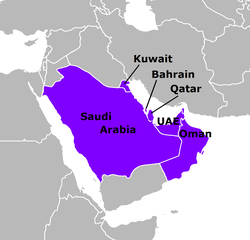
The official name of the GCC is the Cooperation Council for the Arab States of the Gulf. It was established by the governments of Bahrain, Kuwait, Oman, Qatar, Saudi Arabia and the United Arab Emirates on 25 May 1981. The instrument establishing the GCC is called The Charter. The objectives of the GCC mentioned in my previous article are set out in art. 4 of the Charter.

The Institutions
Art 6 of the Charter establishes the following institutions:
  • a Supreme Council with a Commission for the Settlement of Disputes attached;
  • a Ministerial Council; and
  • a Secretariat General.
Supreme Council
Art 7 declares that the Supreme Council is the highest authority of the GCC. It consists of the heads of state of the member states with a rotating presidency. This body meets at least once a year though extraordinary meetings can be convened at the request of any two members. Art 8 lists the Supreme Council's functions as follows:
  • to review matters of interest to the member states;
  • to lay down the higher policy for the GCC and the basic lines it should follow;
  • to review the recommendations, reports, studies and joint ventures submitted by the Ministerial Council for approval;
  • to review reports and studies, which the Secretary-General is charged to prepare;
  • to approve the bases for dealing with other states and international organizations;
  • to approve the rules of procedure of the Commission for the Settlement of Disputes and nominate its members;
  • to appoint the Secretary-General;
  • to amend the Charter;
  • to approve the Supreme Council's internal rules of procedure; and
  • to approve the budget of the Secretariat General.
Each member state has one vote. Resolutions on substantive matters require the unanimous vote of all the member states while resolution on procedural matters may be carried by a simple majority (art 9). The Supreme Council is quorate if two thirds of the member states are present (art 7).

Commission for the Settlement of Disputes
Art 10 provides for a Commission for the Settlement of Disputes to be attached to the Supreme Council. The Supreme Council establishes the composition of the Commission on an ad hoc basis whenever a dispute arises. The Commission reports to the Supreme Council which takes such action upon the Commission's advice or recommendations as it thinks appropriate.

Ministerial Council
The Ministerial Council consists of the foreign ministers of each of the member states (art 11). It meets at least once a quarter and is chaired by the foreign minister of the member state that chairs the Supreme Council for the time being. The Council's functions, which are listed in art 12, are as follows:
  • to propose policies, prepare recommendations, studies and projects aimed at developing cooperation and coordination between member states in various fields and adopt the resolutions or recommendations required in this regard;
  • to endeavour to encourage, develop and coordinate activities existing between member states in all fields;
  • to refer resolutions adopted in such matters to the Ministerial Council with recommendations to the Supreme Council;
  • to submit Council for further submission, with recommendations to the Supreme Council for appropriate action;
  • to submit recommendations to the Ministers concerned to formulate policies whereby the GCC's resolutions may be put into effect;
  • to encourage means of cooperation and coordination between the various private sector activities, develop existing cooperation between the member states' chambers of commerce and industry, and encourage the movement within the GCC of workers who are citizens of the member states.
  • to refer any of the various aspects of cooperation to one or more technical or specialized committees for study and presentation of appropriate recommendations;
  • to review proposals related to amendments to the Charter and submit appropriate recommendations to the Supreme Council;
  • to approve rules of procedure of both the Ministerial Council and the Secretariat General;
  • to appoint assistant Secretaries-General, as nominated by the Secretary-General, for a renewable periods of 3 years;
  • to approve periodic reports as well as internal rules and regulations relating to administrative and financial affairs proposed by the Secretary-General, and submit recommendations to the Supreme Council for approval of the budget of the Secretariat General;
  • to make arrangements for meetings of the Supreme Council and prepare its agenda; and
  • to review matters referred to it by the Supreme Council.
Secretariat General
Art 14 provides for a Secretariat General consisting of a Secretary General and a number of assistants charged with:
  • preparing studies related to cooperation and coordination, and to integrated plans and programmes for action by member states;
  • preparing periodic reports on the work of the GCC;
  • following up the implementation by the member states of the resolutions and recommendations of the Supreme Council and Ministerial Council;
  • preparing reports and studies requested by the Supreme Council and Ministerial Council;
  • preparing the draft of administrative and financial regulations commensurate with the growth of the GCC and its expanding responsibilities;
  • preparing the budgets and closing accounts of the GCC;
  • making preparations for meetings and preparing agendas and draft resolutions for the Ministerial Council;
  • recommending to the Chairman of the Ministerial Council the convening of an extraordinary session of the Council when necessary; and
  • any other tasks entrusted to it by the Supreme Council or Ministerial Council.
The current Secretary General is Abdullatif bin Rashid Al-Zayani of Bahrain who assumed office on 1 April 2011 (see the news report of 31 Match 2011 by the Bahrain News Agency for the announcement of his appointment and his curriculum vitae).

Related Articles
GCC Secretariat General "The Organizational Structure"